

Any time I work with teams who are encountering and negotiating the same decision over and over, I say, “Oh, you need a Divorce Schedule.”
I have divorced parents - they got along okay, but when my sister and I left the nest something kept happening when we were back for holidays or vacations - we would end up each day in a negotiation with nebulous and high stakes. “Are you spending the night here tonight?” asked with the full weight of someone who needed the answer to be yes. Every meal, every night, every hour of each day ended up disappointing someone. Everyone involved ended up exhausted and disappointed.
I complained about this to my therapist. He said, “Oh, that’s easy. You just need a schedule.”
He explained: before you go, write up an email with every day and night mapped out. Which parent, what activity, when. Everyone agrees to it in advance. Every night you go to your dad’s, you tell your mom — it’s the schedule. The decision is made.
It worked immediately. Within a few trips, everyone in the family was asking for the schedule. The drama didn’t disappear, but the daily negotiation did. The decision had already been made. We were just following it.
The Decision Made Framework
The Divorce Schedule belongs to a category of boundaries that I refer to as decision made frameworks.
I’m a big fan of traditional decision-making frameworks. Suzy Welch’s 10-10-10 framework, for example, asks you to consider what you might feel about your decision from three points of view: you 10 minutes from now, you 10 months from now, and you 10 years from now. These type of frameworks are invitations for information-gathering, consequence-weighing, and perspective taking.
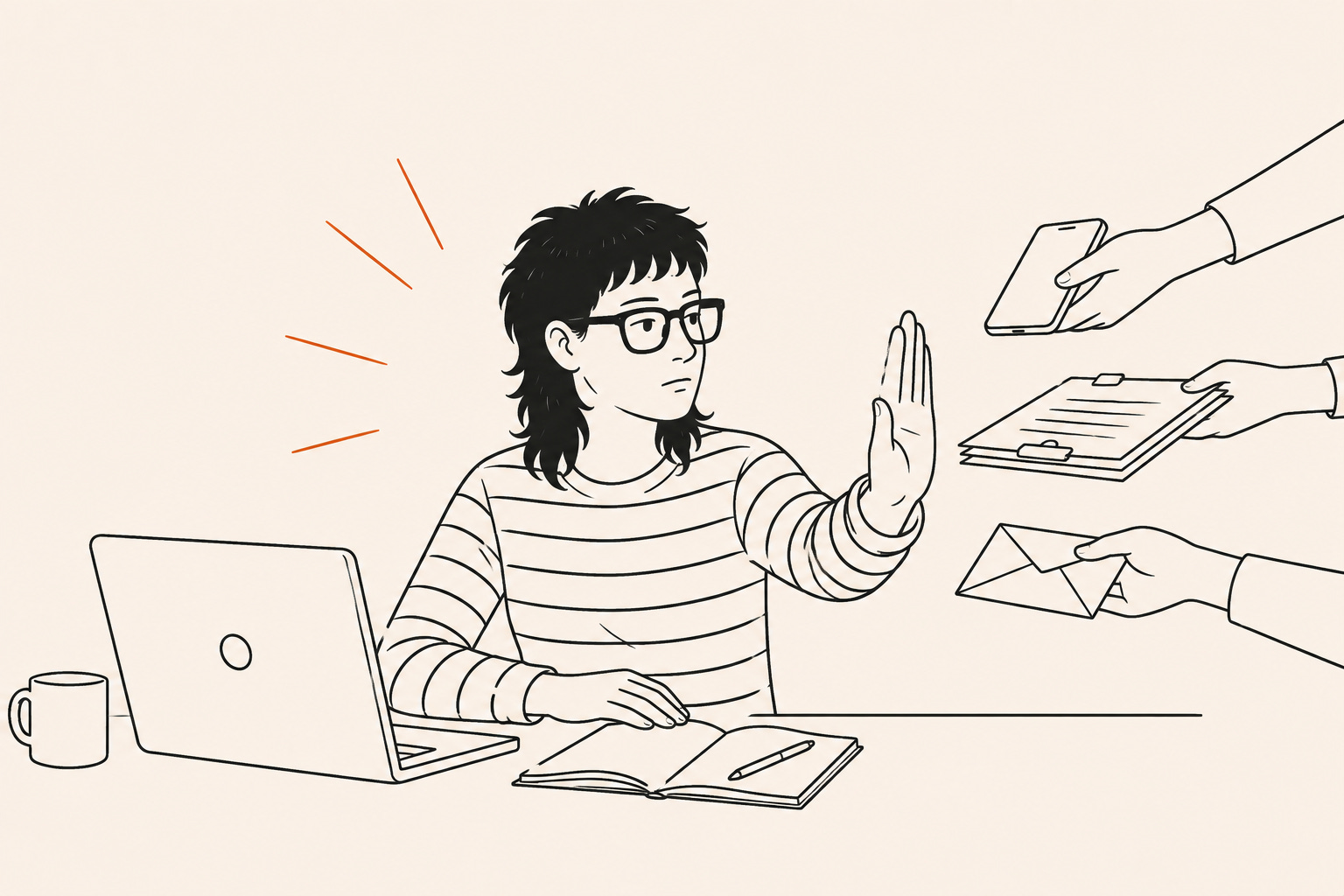
A decision-made framework is different. It’s designed to bypass a moment of conflict. It’s taking the heat out of a situation that might otherwise activate you, where judgement could be clouded by guilt, money, fear, you-name-it. If you know that you’ll be in a situation on a regular basis where you’ll have to negotiate around your own or other people’s complicated emotions - that’s when you need a decision made framework.
A decision you’ve already made requires no willpower in the moment. It keeps you from negotiating against yourself.
This is how you stop overriding your own instincts. The decision has already happened. You just focus on what comes next. The reason most people perseverate over decisions is not that they don’t know what they want. It’s that they’re in conflict about it.
Bypassing the yes’es that are really no’s
I recently went on a walk with a friend I hadn’t seen in awhile - we lingered a bit longer than we planned and she looked at her phone and let out an expletive: “ugh, I told someone I would do this call and I forgot.” Then she paused and said, “You know when you say yes when you mean no? It was one of those.” She also demonstrated what happens when you say yes when you mean no -- you subconsciously sabotage. You forget the meeting. You show up frazzled or late or distracted. Your brain is still saying no, even when you said yes.
This very principle is why Whipsmart, my PR firm, had a rule: we never take business just for the money. There are a lot of great reasons to take on a client - an excellent, visual story, a stunningly good mission, very cool innovation (sorry for the blatant plugs but our clients are the coolest). But without those reasons, a fat retainer is just a recipe for regret. Any time we did it, it was the wrong decision. It’s not easy to turn down money. But it’s easier than trying to get a team to motivate on work they don’t really want to do. It’s better than the diligence it requires to keep from subconsciously undermining the work.
I have a rule that has radically improved my life: if the only reason I’m doing something is fear, obligation, or guilt, I don’t do it.
The word “only” matters. There are plenty of things I do because obligation is part of the picture. I go to work events I’d rather skip because I’m obligated and because I get to connect with colleagues, learn new things, or grow professionally. Those other things make it worth my while. The rule gets enforced when the only argument for saying yes is that my sense of obligation steps in and overrides my no.
You know exactly what I’m describing. It’s the acquaintance whose name appears on your phone and you feel immediately drained -- then, just as quickly, the guilt sets in, and suddenly you have set aside the afternoon to go to coffee instead of . . . literally anything else. Staring at the wall, for example. Taking a nap. That dread you feel? It’s information. It’s telling you that somewhere in the decision, your signal got overridden by noise.
The framework makes the decision clear and, almost every time, it eliminates regret. Just like any boundary, there will be people who don’t like it or understand it. That’s okay. If we spend all our time and energy trying to placate those people, we will not have time and energy for the work of building the life and career we want.
If you want to try this for yourself, start to notice the telltale signs of saying yes when you meant no. Dread, avoidance. Anxiety.
Pick an area -- work, relationships, time — and keep notes about your feelings when you make decisions. Feel it in your body — the pit in your stomach, the slump in your shoulders, the drag in your step. Start to notice when you’re giving the yes’es that mean no, then try to name why. That feeling when you want to cry “for no reason?” that’s the reason.
Then, make a rule. Make a rule that’s specific enough that you could test a decision against it and get a yes or no. Not “I’ll be better about boundaries.” A rule.
The rule won’t protect you from hard situations. But it protects the part of you that knows the answer from the part that’s been trained to override it.
What’s one rule you’ve already made for yourself — the kind that takes a decision off the table before it happens? Hit reply.
If this resonated with someone you know, send it their way.
Yes! This is a lesson I had to force myself to learn. Accepting the answer I had already made and being clear of my intentions was challenging but so worth it.